behavioral
health

Intellectual and Developmental Disabilities

Substance Use Treatment

homeless
services

Integrated
care

behavioral
health

Intellectual and Developmental Disabilities

Substance Use Treatment

homeless
services

Integrated
care

<< back to all events and news

Thank YOU to OTB Hastings

Dec 7, 2022

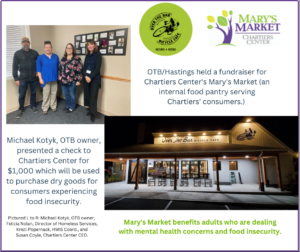
Thank you to Over the Bar Bicycle Café (OTB/Hastings) for their donation to Chartiers Center’s Mary’s Market (an internal food pantry serving Chartiers Center consumers.) Michael Kotyk, OTB owner, is pictured presenting a $1,000 check to Felicia Nolan, Director of Homeless Services, Kristi Popernack, HMIS Coordinator, and Susan Coyle, Chartiers CEO.

Mary’s Market provides weekly bags of dry goods and personal care items to Chartiers Center consumers weekly.


Recent Posts
4 Benefits of Group Therapy

4 Benefits of Group Therapy

Chartiers Center’s Residential Treatment Program (RTP) serves as an alternative to psychiatric hospitalization or as a step-down from inpatient care. The program...

What Is Mobile Psychiatric Rehabilitation?

What Is Mobile Psychiatric Rehabilitation?

Psychiatric Rehabilitation Services are founded on the firm belief that people can and do recover from mental illness, including the most severe and persistent diagnoses. Psych Rehab providers define recovery not by a lack of symptoms, but by the presence of meaning and purpose in one’s life. Participants in Chartiers Center’s Mobile Psych Rehab (MPR) program choose the recovery goals they want to work on and then meet regularly with their MPR staff to learn, enhance, and practice the skills they need to reach those goals.

Healing Invisible Wounds

Healing Invisible Wounds

For many Veterans, the battle doesn’t end when they return home. The experiences of deployment, combat exposure, loss, and the transition back to civilian life can take a profound toll on mental well-being. While every Veteran’s story is unique, the mental-health challenges they face often share common threads: post-traumatic stress, depression, anxiety, substance use, and a lingering sense of isolation. The good news is that effective, compassionate treatment options exist—and awareness and accessibility have grown dramatically over the past decade.