

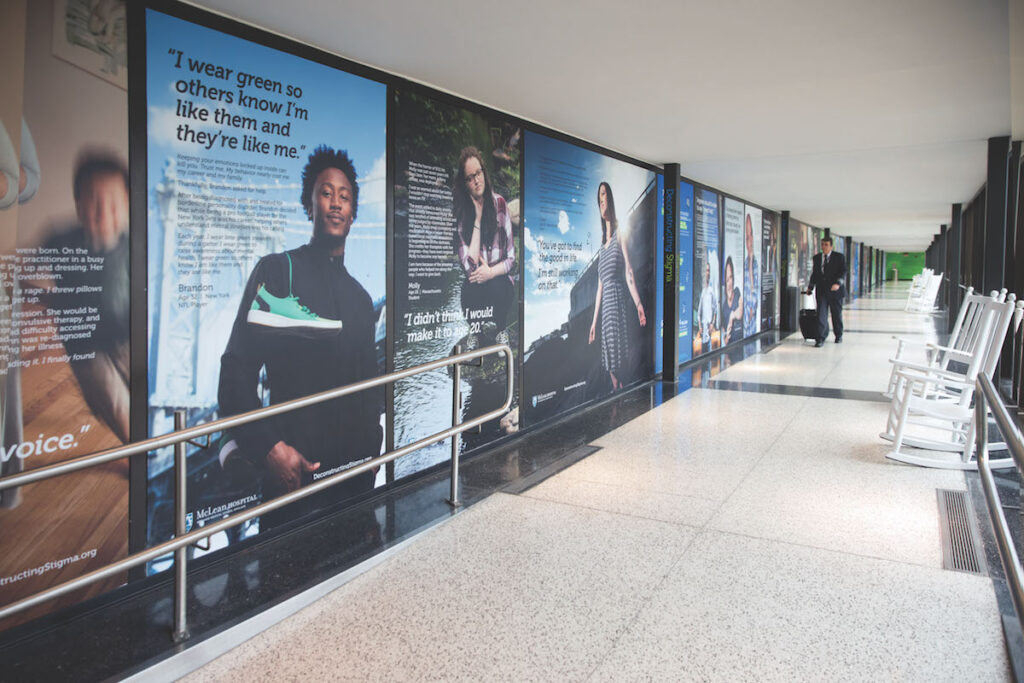
In recognition of May is Mental Health Awareness month we would like to share the following from the Deconstructing Stigma project developed by McLean Hospital. A project that uses larger-than-life photographs and interviews with people who have been affected by mental illness. Each story is told through the eyes of the participants as they tear down the misconceptions of mental health. The volunteers in this project are everyday people—just like you. Click here to read the original article.
The Campaign
 the United States and beyond who have been affected by mental illness. Since the campaign’s initial physical installation at Boston’s Logan International Airport, it has traveled the world with pop-up installations across the United States. The installations, website, and the companion books serve to capture the complexity of living with a psychiatric disorder, seeking treatment, navigating insurance and healthcare systems, and facing stigma.
Told through the eyes of its participants, Deconstructing Stigma boldly tears down the misconceptions of what those with mental illness look like. The volunteers in this project are more than just statistics or nameless faces. They are mothers, fathers, wives, husbands, lawyers, doctors, engineers, musicians, and more. Each one has been affected by mental illness, and each one has also faced stigma.
1 in 5 Americans will experience mental illness in his or her lifetime. It is something that affects us all. If you are struggling with symptoms of an illness, or if you feel like no one would understand what you’re experiencing, this campaign is for you. You are not alone.
This project was developed by McLean Hospital, the largest psychiatric affiliate of Harvard Medical School, in partnership with the American Foundation for Suicide Prevention, the International OCD Foundation, Massachusetts Association for Mental Health, the National Alliance on Mental Illness, and PROJECT 375.
Together, we are deconstructing stigma, and together, we are changing lives.
STORIES